Status: This OS is no longer supported
This article, “How to Install LCMP on CentOS 6 / RHEL 6 / Scientific Linux 6,” covers a version of CentOS that reached end of life (EOL). The developing company no longer supports it. As such, we no longer maintain this guide. If you are currently operating a server running CentOS 6, we highly recommend contacting RoseHosting’s fully managed support. They can upgrade or migrate you to a supported version of AlmaLinux.
 Cherokee is a lightweight, flexible, and completely customizable Web server. Its speed and ease of use makes Cherokee one of the top running alternatives to Apache. Cherokee can be easily be installed using RPM packages or it can be compiled from source. If there is another Web server already installed on your virtual server, it needs to be stopped first.
Installation Instructions
Apache is usually installed by default, so to check if Apache is running, execute the following command:
ps aux | grep httpd
If it is up and running, you need to stop the Apache service:
/etc/init.d/httpd stop
To disable Apache, execute the following command:
chkconfig httpd off
Or, to completely remove Apache from your virtual server, run the following command:
yum remove httpd
Download and install Cherokee and its dependencies:
cd /opt/
wget http://dl.fedoraproject.org/pub/epel/6/i386/cherokee-1.2.101-3.el6.i686.rpm
wget http://dl.fedoraproject.org/pub/epel/6/i386/GeoIP-1.4.8-1.el6.i686.rpm
wget http://dl.fedoraproject.org/pub/epel/6/i386/spawn-fcgi-1.6.3-1.el6.i686.rpm

rpm -Uvh cherokee-1.2.101-3.el6.i686.rpm GeoIP-1.4.8-1.el6.i686.rpm spawn-fcgi-1.6.3-1.el6.i686.rpm

chkconfig cherokee --add
chkconfig cherokee on
chkconfig --list | grep cherokee
The output should be as follows:
cherokee 0:off 1:off 2:on 3:on 4:on 5:on 6:off
Install mysql:
yum install mysql mysql-server
chkconfig --levels 235 mysqld on
/etc/init.d/mysqld star
Create a password for the MySQL ‘root’ user:
mysqladmin -u root password xxxxxxxx
where ‘xxxxxxxx’ will be your new MySQL root password. Install rrdtool and php using the following command:
yum install rrdtool php php-bcmath php-cli php-common php-devel php-gd php-imap php-mbstring php-mcrypt php-mysql php-pdo php-pecl-apc php-pecl-memcache php-pear php-soap php-xml php-xmlrpc
Edit the ‘/etc/php.ini’ file and uncomment this line:
cgi.fix_pathinfo = 1
Execute the following commands:
vi /usr/bin/php-fastcgi
#!/bin/sh
 /usr/bin/spawn-fcgi -a 127.0.0.1 -p 9000 -C 6 -u cherokee -f /usr/bin/php-cgi
chmod 755 /usr/bin/php-fastcgi
Create an init script like this:
vi /etc/init.d/php-fastcgi
#!/bin/bash
#
# php-fastcgi - Use PHP as a FastCGI process via nginx.
#
# chkconfig: - 85 15
# description: Use PHP as a FastCGI process via nginx.
# processname: php-fastcgi
# pidfile: /var/run/php-fastcgi.pid

. /etc/rc.d/init.d/functions

phpfastcgi="/usr/bin/php-fastcgi"
prog=$(basename php-cgi)
cgi='/usr/bin/php-cgi'

lockfile=/var/lock/subsys/php-fastcgi

start() {
 [ -x $phpfastcgi ] || exit 5
 echo -n $"Starting $prog: "
 daemon $phpfastcgi
 retval=$?
 echo
 [ $retval -eq 0 ] && touch $lockfile
 return $retval
 }
stop() {
 echo -n $"Stopping $prog: "
 killproc $prog
 retval=$?
 echo
 [ $retval -eq 0 ] && rm -f $lockfile
 return $retval
 }
restart() {
 stop
 start
 }
rh_status() {
 status $prog
 }
rh_status_q() {
 rh_status >/dev/null 2>&1
 }
case "$1" in
 start)
 rh_status_q && exit 0
 $1
 ;;
 stop)
 rh_status_q || exit 0
 $1
 ;;
 restart)
 $1
 ;;
 status)
 rh_status
 ;;
 *)
 echo $"Usage: $0 {start|stop|status|restart}"
 exit 2
 esac
chmod 755 /etc/init.d/php-fastcgi
chkconfig --add php-fastcgi
chkconfig php-fastcgi on
service php-fastcgi start
Create a self signed certificate:
mkdir /etc/cherokee/ssl/
openssl req -days 720 -new -x509 -nodes -out /etc/cherokee/ssl/cherokee.pem -keyout /etc/cherokee/ssl/cherokee.pem
Edit the Cherokee configuration file (/etc/cherokee/cherokee.conf): Look for the following line:
server!bind!1!port = 80
And add the following lines:
server!bind!2!port = 443
server!bind!2!tls = 1
Add the following lines before # Icons:
vserver!1!rule!105!document_root = /var/www/cherokee
vserver!1!rule!105!handler = fcgi
vserver!1!rule!105!handler!balancer = round_robin
vserver!1!rule!105!handler!balancer!source!10 = 1
vserver!1!rule!105!match = extensions
vserver!1!rule!105!match!check_local_file = 0
vserver!1!rule!105!match!extensions = php,php5
vserver!1!rule!5!encoder!gzip = allow
vserver!1!rule!5!handler = server_info
vserver!1!rule!5!handler!type = just_about
vserver!1!rule!5!match = directory
vserver!1!rule!5!match!directory = /about
source!1!env_inherited = 1
source!1!host = 127.0.0.1:9000
source!1!interpreter = /usr/bin/php-fastcgi
source!1!nick = PHP-FastCGI
source!1!type = interpreter
Restart the Cherokee service for the changes to take effect:
/etc/init.d/cherokee restart
Cherokee can be configured via web interface, which can be started using the following command:
cherokee-admin -b xxx.xxx.xxx.xxx
where ‘xxx.xxx.xxx.xxx’ is your virtual server IP address. The output of this command will show the login credentials and the URL of the web interface:
Login:
 User:              admin
 One-time Password: 6rvl9m0HD4Zr7bP5
Web Interface:
 URL:               http://Your_VPS-IP-address:9090
Congratulations
Cherokee’s admin will now be listening on port 9090 of your virtual server, so you can open http://Your_VPS-IP-address:9090 using a web browser: 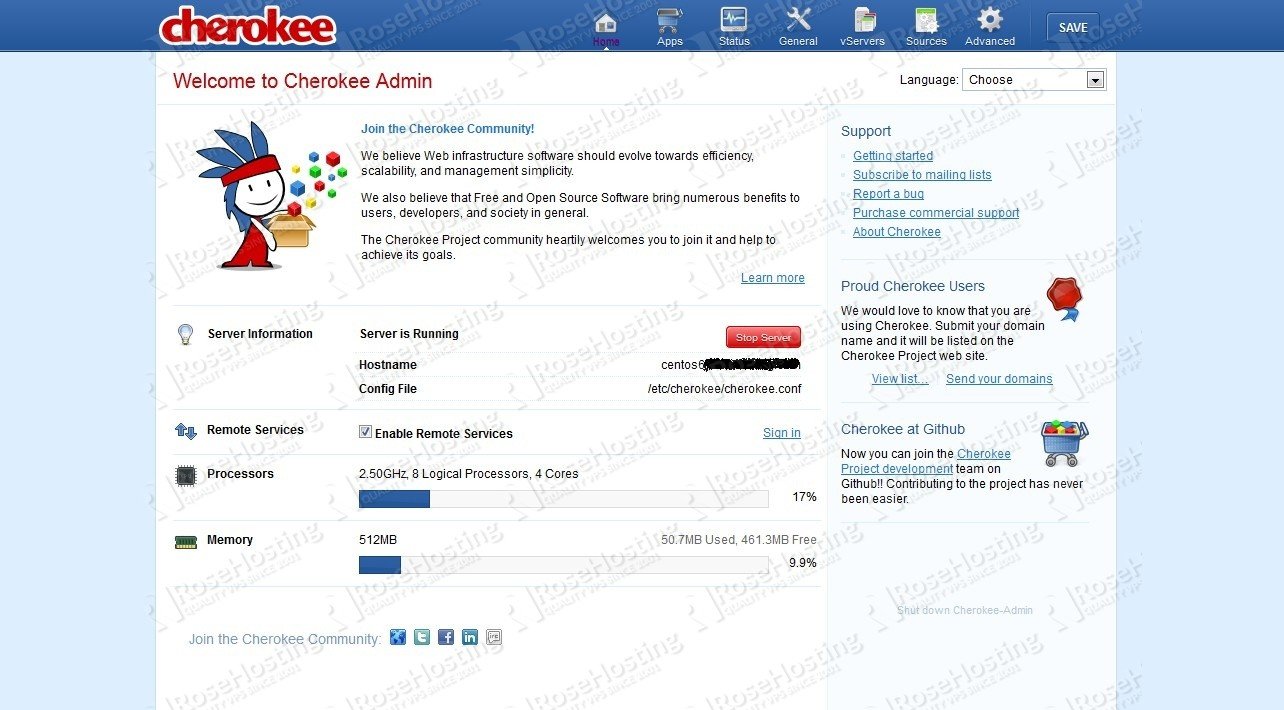 To add a new virtual host in Cherokee, follow the instructions below: Log in at http://Your_VPS-IP-address:9090 and click the ‘vServers’ icon from the top-menu. Then, click the ‘+’ button next to ‘Virtual Servers’:
 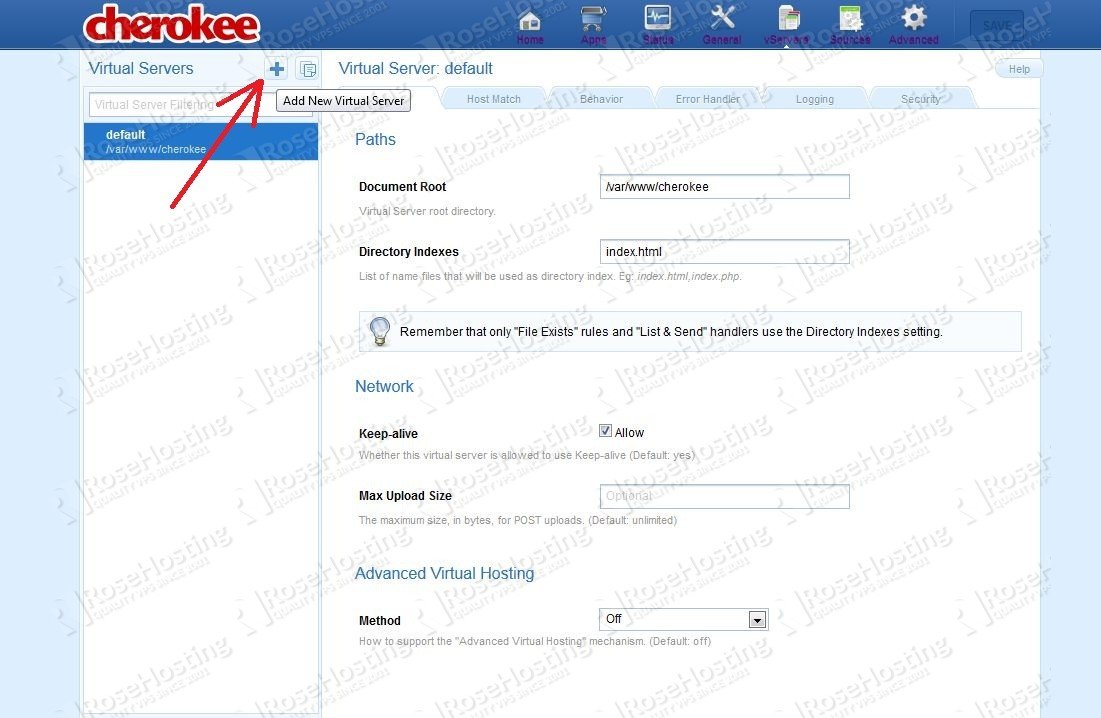 Select ‘Languages’, then select ‘PHP’, click ‘Add’, ‘Next’, then set ‘/var/www/path_to_your_domain.com_website_files’ as Document Root, add ‘www.your_domain.com’ to the ‘New Host Name’ field and click ‘Create’. Using the Cherokee web interface you can easily install WordPress, Joomla, Drupal, Zen Cart, OpenX, Sugar CE, Moodle, phpBB, MediaWiki, Redmine, Trac and other polupar applications. Of course you don’t have to do any of this if you use one of our Linux VPS Hosting services, in which case you can simply ask our expert Linux admins to install Cherokee for you. They are available 24×7 and will take care of your request immediately. PS. If you liked this post please share it with your friends on the social networks using the buttons on the left or simply leave a reply below. Thanks.
Could you elaborate on the reasons/advantages for the init script and /usr/bin/spawn-fcgi over the cherokee default of setting the interpreter to /usr/bin/php-cgi -b localhost:port ?
Unfortunately the directions for making phpfastcgi init service (/etc/init.d/php-fastcgi) as it seems, not working….
In centos 6.5 with epel & remi repos.
If you just copy/paste the init file, you getting:
[root@**** init.d]# chkconfig –add php-fastcgi
service php-fastcgi does not support chkconfig
and if you try to run it (/etc/init.d/php-fastcgi start) you getting:
Starting : /etc/init.d/php-fastcgi: line 4: daemon: command not found
So i think this tutorial/article, needs some fixing. Currently it does not working :)
“and is a great tutorial :) “
Add the following line:
#!/bin/bash
to the beginning of /etc/init.d/php-fastcgi
Hi There,
I get the same error….
[root@**** init.d]# chkconfig –add php-fastcgi
service php-fastcgi does not support chkconfig
and if you try to run it (/etc/init.d/php-fastcgi start) you getting:
Starting : /etc/init.d/php-fastcgi: line 4: daemon: command not found
If I just go by this and do everything else and try to open a php file it tries to download the file instead of running it.
Use the following command to enable php-fastcgi on boot:
As for the php-fastcgi init script, make sure it has the following line: